Engaging for Equity
Join us April 21, 2020 for our next Virtual Learning Conversation (VLC)
Draft Agenda
Impacted communities and communities of color across the nation are working hard and spending funding to advocate for their interests of the communities to decisionmakers, boards, and government entities. What if space and resources for community members were built into the process? What if community members didn’t have to fight an unjust or inequitable decision, because they had a seat at the decision-making table? What does this process look like in a world with COVID-19? What are the challenges being faced, and are there opportunities to change the status-quo process we can work on now?
We will join together virtually on April 21st from 1-2:30pm ET with SPARCC partners across the United States (including partners from Atlanta, Chicago, Denver, Memphis, and the San Francisco Bay Area) for shared learning.
The virtual learning conversation is designed to grow our equitable development community of practice in three ways.
- Provide an opportunity to increase our shared knowledge
- Bring partners together across local regions to learn targeted strategies
- Create broader connections across public, private and advocacy sectors
SPARCC partner, Mariia Zimmerman of MZ Strategies, LLC, will share highlights from the December 2019 SPARCC publication, Inclusive Investment Starts with Equitable Community Engagement which lifts up the emerging practices being implemented in city departments, transit agencies, and regional planning organizations to elevate and adequately resource community organizations, local residents and business owners to be engagement partners. We will have time for peer exchange and discussion of the innovative approaches, barriers and opportunities we collectively are facing in doing this work in a time of physical distancing.
The Virtual Learning Conversation is not limited to SPARCC affiliates and partners.
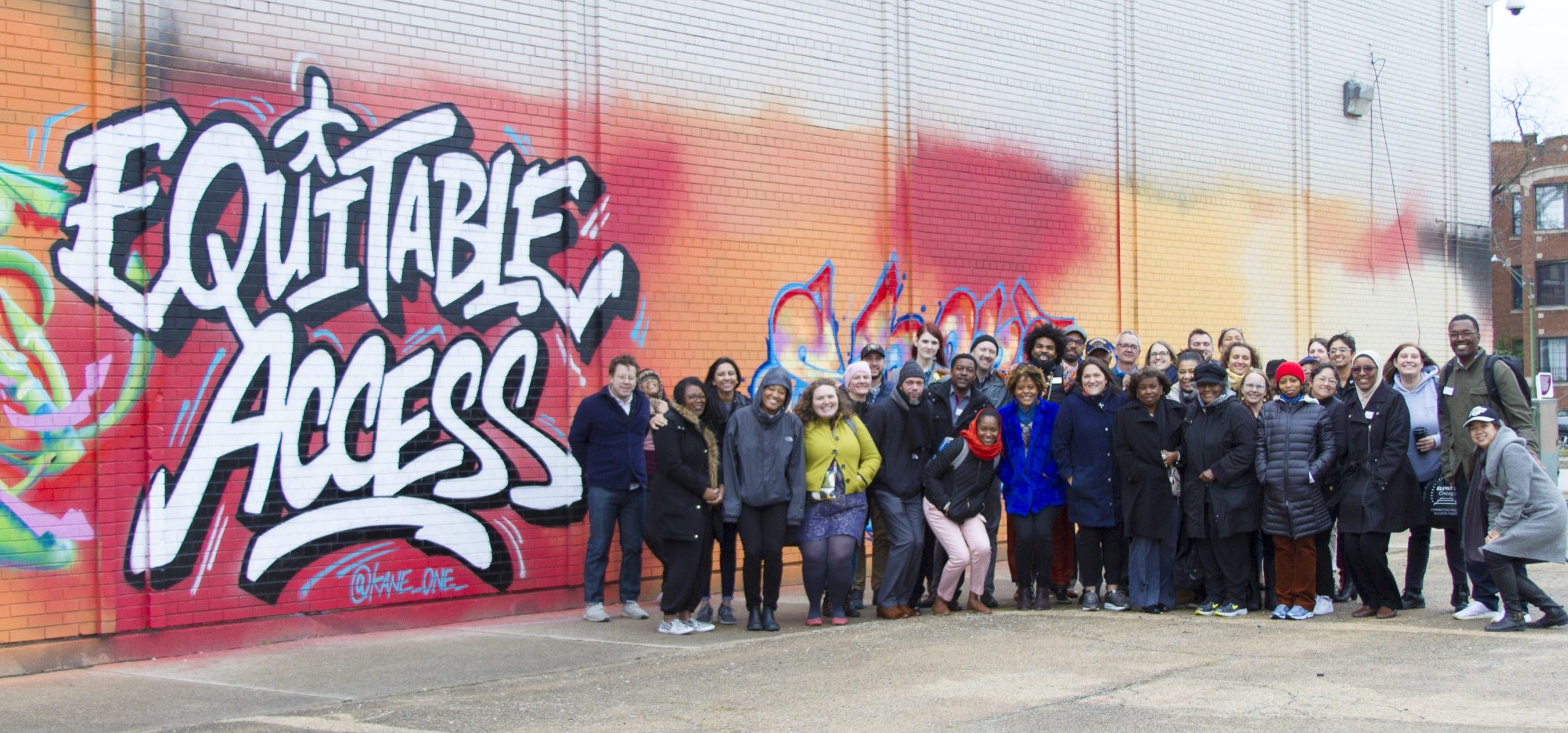 SPARCC Convening – Chicago 2019 – mural by David Anthony
About VLCs
Within the community development sector, we are faced with the consistent theme of displacement and gentrification triggered by large scale infrastructure and development initiatives. Whether it’s transit, housing or parks, the outcomes are the same – new development propels a community in a different economic direction, causing a rise in land and housing values which can price out and displace longtime residents, often low-income and people of color. Transforming this narrative requires a fundamental shift in how we approach development, with community being firmly centered in the planning, decision-making and implementation.
This transformation can take many shapes, and cuts across the myriad of community development levers from affordable housing to parks and open space, to planning processes and capital investment models. In 2019, SPARCC hosted its first VLC focused on parks and urban open space inequality. We brought together cross-sector partners from across five sites to share work underway to increase knowledge, provide strategies, and create connections to understanding the connection of parks, green infrastructure, racial equity, environmental justice and community development. But that was just the beginning.
In 2020, SPARCC will host two VLC’s that further the conversation on inclusive, community-led investment. The first VLC will focus on practices that public agencies can utilize to more authentically partner with locally based organizations to advance equitable community engagement in a World with COVID-19. The second VLC will explore emerging strategies for community-ownership models and innovative ways to utilize capital resources to support this work. Work is already underway to plan the first VLC, scheduled for March 2020.
Past VLCs
You can watch recordings and read takeaways from previous VLCs here:
How Parks Can Be a Catalyst for Positive Change in Communities